
Inheritance and Wills Lawyer: A Comprehensive Guide to Choosing a Specialist and Understanding the Process
Estimated reading time: 18 minutes
Inheritance and wills concern sensitive, complex moments in every family. Beyond the emotions, this legal field demands deep expertise, procedural knowledge and the ability to navigate competing interests. A. Shiloh & Co., established over seventy years ago, combines a long professional tradition with personal support tailored to each case.
Choosing an inheritance and wills lawyer carefully is vital to protecting your rights and handling proceedings efficiently. Quality advice before an inheritance or probate order can prevent future disputes and save time, money and distress.
Key Points to Remember
- ✓ A professionally drafted will prevents disputes and ensures your wishes are honored
- ✓ Early legal advice saves major costs and distress later
- ✓ Understanding the crucial difference between inheritance and probate orders is essential
- ✓ Estate debts must be paid before assets are distributed
- ✓ Land-registry inheritance registration is the final step in exercising property rights
Contents: Quick Guide Navigation Click to Expand
- What Does an Inheritance and Wills Lawyer Do?
- When Do You Really Need Legal Advice?
- What Is a Will, and Why Make One in Advance?
- Choosing the Right Type of Will
- Inheritance and Estate: What Is the Difference?
- Inheritance Order and Probate Order: Practical Differences
- Obtaining an Inheritance Order: Main Steps
- Documents to Prepare Before Meeting a Lawyer
- A Parent Dies Without a Will: What Next?
- How Long Does an Inheritance Order Take?
- Is a Lawyer Required to Obtain an Order?
- Distribution Without a Will: How Does It Work?
- Common Mistake: Ignoring Estate Debts
- When Are Wills Challenged?
- Proving Undue Influence
- Amending or Canceling Existing Orders
- When Is an Estate Administrator Necessary?
- Fees and Exemptions
- Inheritance Registrar or Rabbinical Court
- Inheritance Registration at the Land Registry: The Final Step
- Checks Before Signing an Estate Distribution Agreement
- Frequently Asked Questions on Wills and Inheritance
What Does an Inheritance and Wills Lawyer Do?
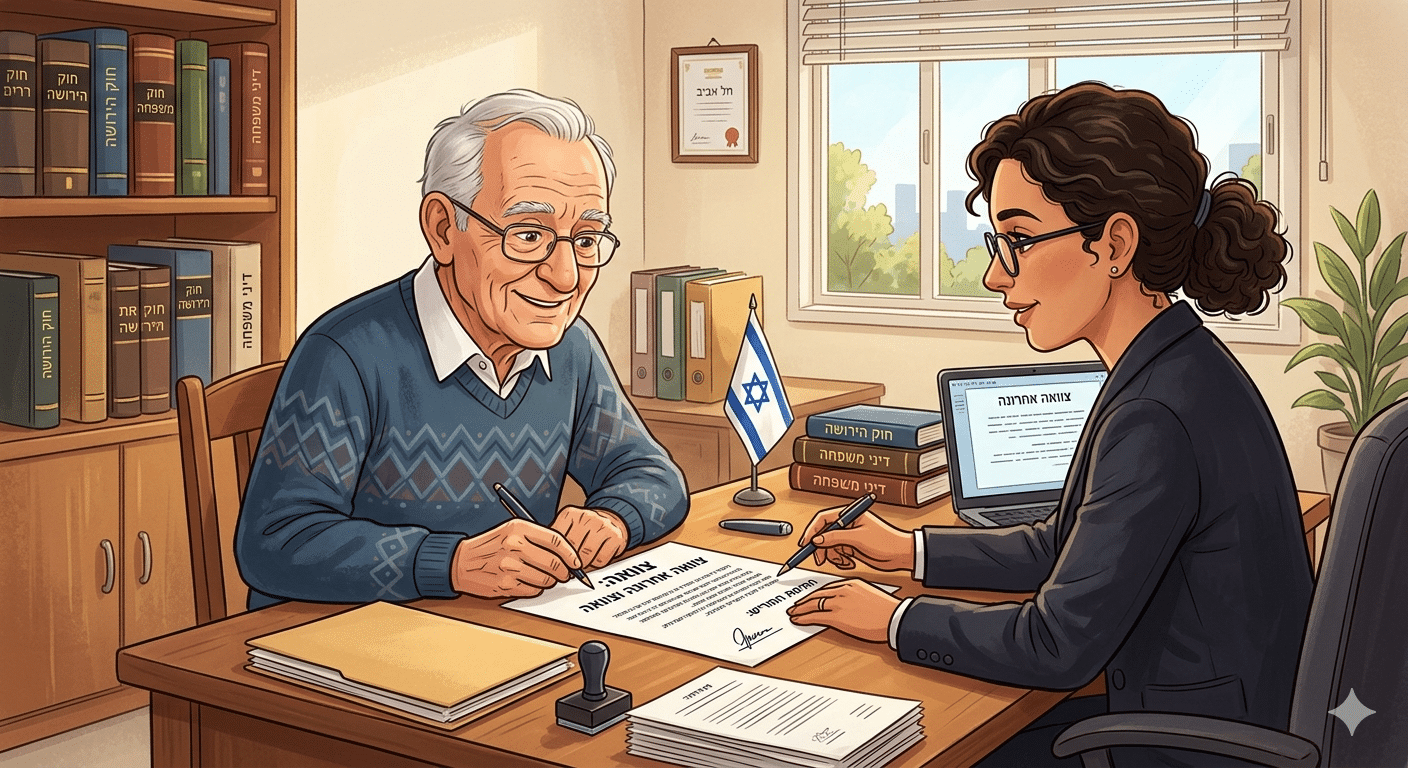
The lawyer supports clients before and after death. Beforehand, they draft a valid, precise will suited to the client’s family and assets. After death, they obtain orders, gather documents and help heirs deal with the relevant bodies.
The role also includes family inheritance litigation, will challenges and complex estate distribution. A skilled lawyer identifies potential friction early and acts to prevent it.
When Is Advice Needed, and When Can You Manage Alone?
Legal support is not always necessary. In straightforward cases with clear heirs, no disputes and no unusual assets, applications may sometimes be filed independently. In most cases, however, advice prevents later difficulties.
Warning signs include common-law partners, children from earlier marriages, numerous or complex assets, the deceased’s debts and strained family relationships. Mistakes in these situations can cost far more than legal fees.
What Is a Will, and Why Prepare It Early?
A will directs how property is distributed after death. It ensures wishes are respected and substantially reduces inheritance disputes. Without one, statutory rules apply, which may not reflect the deceased’s intentions.
The law recognizes handwritten wills, witnessed wills, wills before an authority and oral wills, reserved for exceptional circumstances. Each has formal requirements whose breach may invalidate it.
The Inheritance Law permits spouses to make a mutual willthat ensures their accumulated assets pass to heirs in the manner agreed by both spouses so that after the first dies, the survivor cannot alter its provisions.
How Do You Choose the Appropriate Will?
The choice depends on personal circumstances, the marital relationship, asset complexity and the testator’s health. Witnessed wills are most common and usually appropriate. A notarial will offers additional protection and may suit sensitive situations or anticipated challenges.
A. Shiloh & Co. drafts all types of wills, including notarial wills, with personal, professional service.
What Is the Difference Between Inheritance and the Estate?
Often confused, these terms differ importantly. The estate comprises all assets, rights and debts left by the deceased: financial obligations as well as what heirs receive.
Inheritance is the process and result of transferring that estate to heirs, under a will or by law. The distinction matters for heirs’ liability and paying debts before distribution.
Some assets are legally excluded from the estate, such as insurance payments, while others cannot be inherited by more than one heir, such as an agricultural holding.
A. Shiloh & Co. specializes in wills involving special assets subject to particular Inheritance Law conditions.
Inheritance Order or Probate Order: What Is the Practical Difference?
An inheritance order applies when no will was left and assets pass under statutory rules. A probate order gives an existing will official effect.
Both are key documents for transferring asset rights, handling bank accounts and registration at the Land Registry or Israel Land Authority. Most distribution steps cannot be completed without the appropriate order.
| Criterion | Inheritance order | Probate order |
|---|---|---|
| When issued | No will | A will exists |
| Distribution basis | Statutory succession | The will |
| Issuing body | Inheritance Registrar or rabbinical court | Inheritance Registrar or rabbinical court |
| Required document | Heir details and death documents | Original will and supporting documents |
Obtaining an Inheritance Order: Main Stages
Apply through the Inheritance Registrar or rabbinical court, preparing heir and identification details, death documents and any necessary affidavits. National digital identification allows the online system to complete details from the Interior Ministry.
After filing, public notice is published and an objection period begins. If there are no objections and everything is in order, the order issues. Common errors include inconsistent details, omitted heirs or missing proof of kinship.
What Should You Prepare Before Meeting a Lawyer?
Preparation saves time. Bring the death certificate, potential heirs’ identity documents, proof of family relationships and details of assets and debts.
Bring the original will if one exists. A will deposited with the Registrar can be located by an appropriate request. Advance deposit ensures it can be found after death.
Common Scenario: A Parent Dies Without a Will
Once you have checked that no will was deposited with the Registrar, establish the statutory heirs. The law sets priorities: spouse and children first, followed by parents and siblings.
File the application with all documents. Ensure every heir knows about it and anticipate objections. Complex family structures particularly warrant legal advice.

How Long Does an Inheritance or Probate Order Take?
Timing depends on workload and complexity. Simple uncontested cases may take a few months; objections or missing documents can cause substantial delay.
Requests for additional information, difficulty locating heirs and publication requirements cause delays. Complete, organized files and agreement among heirs shorten them.
Do You Need a Lawyer to Obtain an Order?
Not always legally. Applications may be filed independently through the Registrar’s online system. Nevertheless, legal support is often advisable and worthwhile.
Lawyers add value through correct applications, appropriate strategy and reduced friction. Procedural errors can trigger delays and unnecessary proceedings costing more than the original fee.
Distribution Without a Will: How Does It Work in Practice?
The Inheritance Law determines heirs and shares. The deceased’s spouse receives half, and children share the other half. Without children, the spouse receives a larger share.
Complex families raise interpretive questions. Common-law partners must prove their status. Children from prior marriages have the same rights as others, which may create tension.
Common Mistake: Ignoring Estate Debts
Many heirs focus on assets and overlook loans, mortgages, debts to authorities and other obligations. These must be paid from the estate before distribution.
Assess all debts before deciding distribution. Some estates are “negative,” with liabilities exceeding asset value.
When Are Objections to a Will Raised?
Objections to inheritance or probate orders follow publication and precede issuance. Common grounds include incapacity when the will was made, undue influence, forgery or overlooked additional heirs.
The Registrar first handles proceedings. If the dispute cannot be resolved, it goes to family court. An experienced lawyer represents applicants or objectors.
How Is Undue Influence Proven?
This common challenge requires evidence of the testator’s health or cognitive condition and another person’s influence impairing free will. Evidence may include isolation, financial or emotional dependence and unusual testamentary changes.
Courts examine execution circumstances, the relationship with the main beneficiary and the provisions’ internal logic. Medical records and testimony from acquaintances are crucial.
When Can Existing Orders Be Amended or Canceled?
In some cases, errors, newly discovered information or changed circumstances justify an application to the Registrar supported by documents.
Amendment corrects technical mistakes, such as a name or share. Cancellation is more substantial, for instance when an unknown will emerges or the order relied on incorrect information.
When Is an Estate Administrator Necessary?
An administrator is appointed for complex estates or potential disputes, collecting assets, paying debts and distributing under the law or will.
Appointment may accompany the inheritance or probate application. The administrator files an inventory and periodic reports with the Administrator General, ensuring oversight.
| Business or family need | How A. Shiloh & Co. Helps |
|---|---|
| Complex will | Professional drafting tailored to family and assets |
| Obtaining orders | Full support with applications and documents |
| Inheritance disputes | Representation in objections and court |
| Complex estate management | Administrator appointment and supervision assistance |
| Asset registration | Inheritance registration at the Land Registry and other bodies |
Fees and Exemptions: What Should You Know?
Applications carry fees, periodically updated and published on the Registrar’s website. Exemptions may be requested in some circumstances.
Regulatory conditions mainly concern financial inability to pay, supported by appropriate evidence. Legal advice helps explain eligibility and prepare applications.
Comparison: Inheritance Registrar and Rabbinical Court
Both may issue inheritance and probate orders. The choice depends on circumstances and family preferences.
Rabbinical court may suit those seeking Jewish-law proceedings. Once one body is seized, a parallel application to the other is not possible. Choose carefully at the outset.
Inheritance Registration at the Land Registry: The Final Step
After receiving the order, register real-estate rights with the Land Registration and Settlement Authority, submitting the order and other documents.
Registration is essential for sale, mortgage or transfer. Without updated registration, heirs cannot transact in the property. A. Shiloh & Co., also specializing in real estate, guides clients through this stage.
Checks Before Signing an Estate Distribution Agreement
Record agreed distribution in writing. Before signing, check that all assets are identified, debts considered and any valuation needs addressed.
Examine tax consequences too. Distribution departing from statutory or testamentary shares may be treated as a taxable transaction. Advance advice prevents surprises.
Frequently Asked Questions on Inheritance and Wills
Can a Signed Will Be Changed?+
Yes, while legally capable, the testator may change it at any time by a new will revoking the old one or a codicil. A specialist’s assistance is recommended. The answer differs for amutual will —changing it requires written notice to the other spouse.
What If an Heir Dies Before Distribution?+
Their share passes to their own heirs. This may complicate matters and require another inheritance order. Act promptly with suitable advice.
Can a Common-Law Partner Inherit?+
Yes, the Inheritance Law gives common-law partners spousal inheritance rights. Their status must be proven, potentially through evidence of cohabitation and a shared household.
What Does a Lawyer-Drafted Will Cost?+
Cost varies with type and complexity. Simple wills cost less than those with many assets or special instructions; notarial wills incur an additional charge. Obtain a quotation beforehand.
What If the Original Will Cannot Be Found?+
A deposited will can be located through the Registrar. If not deposited and missing, obtain legal advice. A copy may sometimes suffice, but additional proof is required.
What Is Your Next Step?
Facing inheritance or will questions? Want a will reflecting your wishes and preventing future disputes? Seek professional advice from a specialist.
With over seventy years’ experience, A. Shiloh & Co. provides personal, professional support in wills and inheritance law. Contact our office for an initial consultation. We will gladly help.
About the Author

Adv. Uri Shiloh
A lawyer since 1985, practicing litigation, real estate, cooperatives, inheritance, entrepreneurship and innovation. Arbitrator and mediator in commercial and planning matters and disputes with public authorities. Specializes in managing complex crises outside court.
Legal adviser and notary
Qualified arbitrator and mediator
Member of the Bar Association’s Computing Committee