
Property and real-estate lawyer: the complete guide to transactions and legal issues
Property transactions are among life’s most significant financial decisions. Whether buying a first home, selling an investment property or entering an urban-renewal project, the right legal support makes the difference between a successful transaction and costly complications. This guide brings together essential information for anyone entering a property transaction, emphasising the central role of a property and real-estate lawyer.
Estimated reading time: 18 minutes
Key points to remember
- ✓A property lawyer identifies risks that non-professionals miss and protects hundreds of thousands of shekels.
- ✓Checking the Land Registry extract and planning status is critical before any contractual commitment.
- ✓Buying from a developer requires checking guarantees, technical specifications and compensation for delays.
- ✓Proper tax planning can save tens or even hundreds of thousands of shekels.
- ✓Tax declarations must be submitted within 30 days; failure to comply brings penalties.
Contents Click to expand
- The role of a property and real-estate lawyer
- When do you need a property lawyer?
- Transactions requiring special attention
- Questions for an introductory meeting
- Warning signs of a problem
- Property lawyers’ fees
- Checking a Land Registry extract
- Land Registry, Israel Land Authority and housing companies
- Cautionary notes
- Title checks
- Planning checks
- Debts and levies
- Purchase tax
- Land appreciation tax
- Submitting tax declarations
- Buying an apartment from a developer
- Developer guarantees and security
- Late delivery
- Urban renewal
- Representing residents in renewal projects
- Dangerous contractual clauses
- Working with E. Shiloh & Co.
- Benefits of professional legal support
- Income-producing property investments
- Frequently asked questions
What does a property and real-estate lawyer actually do?
A property and real-estate lawyer supports the client through every stage, from checking the property to final registration of rights. The role includes comprehensive due diligence, negotiating contractual terms, drafting or reviewing agreements and representation before government authorities. An experienced lawyer identifies legal risks that non-professionals may miss and ensures that the client’s interests are protected at every stage.
Legal support is not limited to signing documents. Quality property advice includes coordinating with mortgage banks, filing tax declarations, registering cautionary notes and handling all bureaucracy necessary to complete the transaction. The lawyer safeguards the client’s money and property rights.
When is a property lawyer essential, and when might other arrangements suffice?
In property sales, legal support is practically essential. The reason is simple: every contractual clause may affect hundreds of thousands of shekels, and correcting mistakes later is far more expensive and complicated than investing in proper representation from the outset. Developer purchases, resale transactions, urban-renewal projects and commercial-property transactions all require professional representation.
Cases where limited advice may suffice
For straightforward short-term leases, some tenants choose standard contracts. Yet leases also involve risks: unbalanced guarantees, problematic early-termination clauses or poorly defined repair obligations. A short legal consultation before signing is considerably preferable to using a generic internet template.
How do you identify a transaction requiring special attention?
Not all property transactions are alike. Some require more extensive investigation and specific experience. A property with a complex legal history, unauthorised building work or joint ownership by several heirs carries greater risk.
Other signs of an unusual transaction include a price substantially below market value, pressure from the seller to sign quickly or refusal to provide basic documents. An experienced property lawyer can identify potential problems and propose solutions.
Questions to ask at your first meeting with a lawyer
Choosing a lawyer for a property transaction should not be left to chance. Ask focused questions: What experience do you have with this specific type of transaction? Who will actually handle the file? What timetable is expected? Which checks are included? The answers will help determine whether the lawyer is a good fit.
Clarify the pricing model in advance: is it a fixed fee or a percentage of the transaction value? What is included and charged separately? Financial transparency demonstrates professionalism and prevents surprises.
Warning signs of a potential problem
A lawyer who guarantees absolute results, offers a price substantially below customary levels or is unavailable for basic questions before signing a fee agreement should arouse suspicion. The same applies to a lawyer who does not specialise in property and offers to handle the transaction as part of a general service.
Another warning sign is unwillingness to explain the process clearly. A good lawyer makes complex legal concepts accessible and ensures that clients understand what they are signing.
How much does a property and real-estate lawyer cost?
Fees vary according to transaction complexity, property type and the extent of required checks. For standard transactions, the fee generally takes the form of a percentage of the transaction value or a fixed amount agreed in advance.
Common pricing models
The most common model is a percentage of transaction value, generally 0.5%–1.5% plus VAT, depending on size and complexity. Another is a fixed fee agreed in advance, regardless of property value. Combined models also exist, comprising a base payment and additional payments by stage.
What distinguishes a cheap quote from good value?
An exceptionally low quote may indicate a limited service. Check what is included: preliminary investigations, tax reporting, support during the mortgage process and final registration. A lawyer offering an attractive price but charging extra for every action may ultimately cost more.
Checking a Land Registry extract: what to look for and why it matters
A Land Registry extract is an official document showing the property’s rights status. It identifies registered owners, charges and mortgages, attachments, cautionary notes and additional rights such as easements. An extract can be obtained online through the Ministry of Justice website.
The property lawyer examines it carefully and checks for inconsistencies between the seller’s information and the official record. This is essential before any contractual commitment.
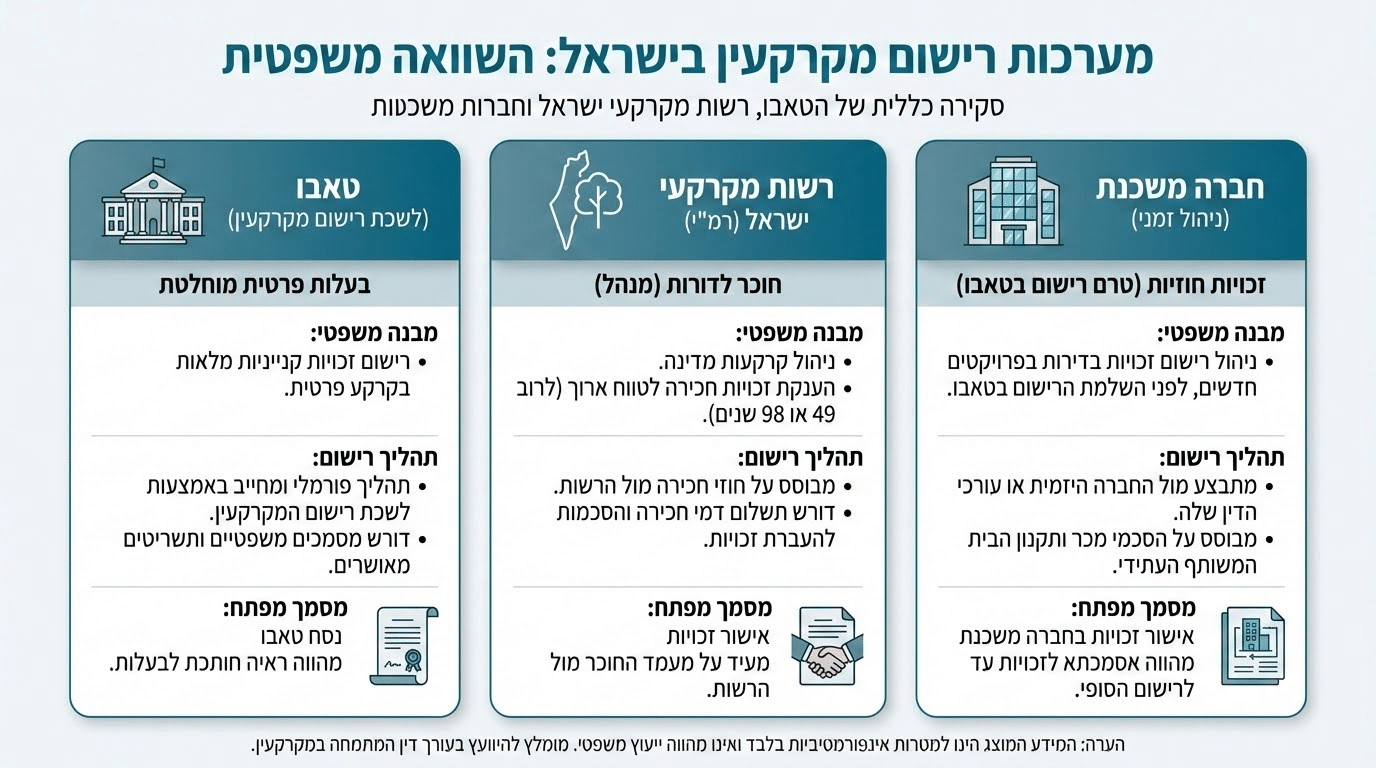
What is the difference between the Land Registry, Israel Land Authority and a housing company?
Not all properties are registered in the same place. Properties registered at the Land Registry, known as “Tabu”, have full proprietary registration in the land registers. Properties managed by the Israel Land Authority are recorded in its systems, sometimes as long-term leasehold rather than full ownership. In some older projects, rights are still registered with a housing company.
| Registration body | Type of right | Implications for the transaction |
|---|---|---|
| Land Registry | Full ownership | Direct and relatively quick registration |
| Israel Land Authority | Long-term leasehold | Transfer approval and sometimes consent fees required |
| Housing company | Contractual rights | More complex process, depending on the company |
Information on registration and transfers is available on the government website for the Land Registry and the Israel Land Authority website for state properties.
What is a cautionary note, and why is it so important?
A cautionary note is an entry in the land registers recording an undertaking to transact in a property or refrain from doing so. It protects buyers against entering a risky transaction and/or a double sale of the same property, and against additional charges or attachments registered after the contract is signed.
Registering a cautionary note is one of the lawyer’s first actions after signing. It can be done through the Land Registry’s online service. Timing is critical: earlier registration provides better protection.
Title checks before buying
Beyond the Land Registry extract, a property lawyer conducts further title investigations. These include verifying the owner’s identity against identification documents, examining the extent and content of rights, and checking for appurtenant areas such as parking or storage.
Checks are more complex for properties outside the Land Registry. Lease documents with the Israel Land Authority must be examined, outstanding debts checked and any requirement for transfer approval established.

Planning checks: why appearances are not enough
Planning due diligence compares the property’s physical condition with its approved building permits. Building violations, unauthorised additions or nonconforming use may result in fines, demolition orders and reduced value.
An experienced lawyer requests the building file from the local committee, examines applicable town plans and ensures that everything on site is authorised. Checking building rights and apartment extensions is particularly important for buyers planning renovations or future extensions. An engineering opinion on the apartment’s condition is recommended to ensure the purchase will not require enormous repair expenditure.
A common mistake: ignoring debts and levies
Many buyers focus on the price and forget existing debts. Betterment levies, municipal taxes, building committee charges and water debts may burden the buyer if not settled before rights are transferred.
Betterment levies can be substantial, particularly in areas affected by planning changes. Information is available on local-authority websites, such as Tel Aviv–Yafo Municipality.
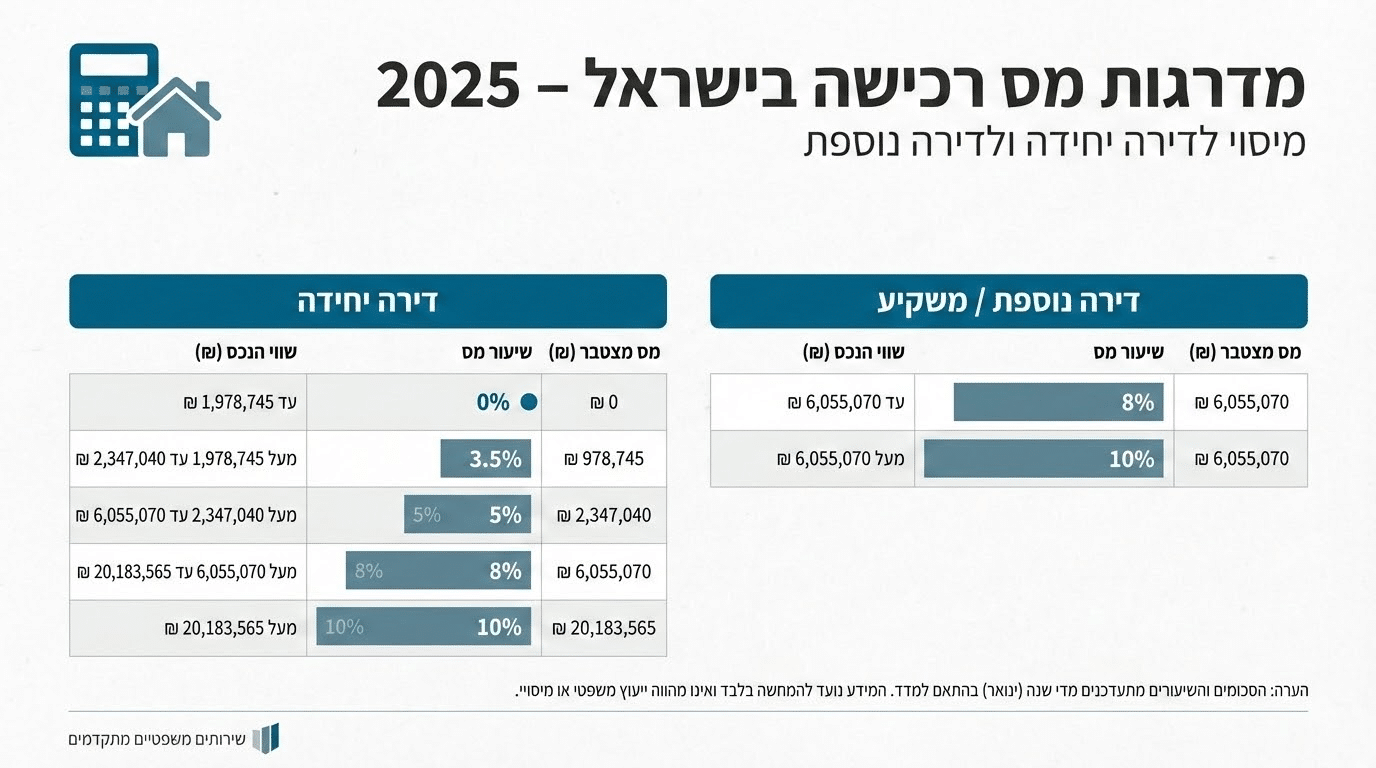
Purchase tax: calculation and advance preparation
Purchase tax is levied on property buyers as a percentage of transaction value. Rates vary by property value and whether it is the buyer’s sole or an additional apartment. Authorities update the tax bands periodically.
| Purchase type | Tax bands | Key points |
|---|---|---|
| Sole apartment | 0%–10% by band | Partial exemption up to a specified threshold |
| Additional apartment | 8%–10% | Higher rates from the first shekel |
| Commercial property | 6% | Flat rate |
Expected tax can be calculated using the Tax Authority’s official calculator.
Land appreciation tax: when does it apply, and what exemptions are available?
Land appreciation tax is imposed on sellers and calculated on the profit from selling the property. The calculation considers the original purchase price, deductible expenses and appreciation over time. Several exemptions exist, including sale of a qualifying residential apartment under certain conditions.
Proper, legitimate tax planning can save tens or hundreds of thousands of shekels. Professional property advice includes examining exemptions and planning the timing of a sale accordingly.
Tax declarations: critical deadlines
The law requires a property-transaction declaration within 30 days of signing the contract. Late submission may result in penalties and interest. The property lawyer handles filing and ensures deadlines are met.
If an assessment is disputed, an objection may be submitted within 30 days of receiving it. This requires professional reasoning and knowledge of tax law, so assistance from an experienced tax lawyer is advisable.
Buying from a developer: how does it differ from a resale?
Buying an apartment from a developer presents unique challenges. The developer drafts the contract in its favour, timetables are long and sometimes uncertain, and buyers usually pay for a property that does not yet exist. The Sale (Apartments) Law is intended to protect buyers in these circumstances, but protection is effective only when they know to demand it.
A lawyer reviewing a developer’s contract checks the validity of guarantees, the adequacy of delay compensation and the detail of technical specifications. Thorough review before signing can prevent many later problems.
Developer guarantees and security: what must you demand?
The Sale (Apartments) Law requires developers to provide security for buyers’ money. The most common form is a bank guarantee, but insurance policies or registration of a cautionary note are other options.
The lawyer ensures each payment is backed by appropriate security for the construction stage. The guarantee’s wording must match the statutory wording. Information is available from the Ministry of Construction and Housing’s Apartment Buyers Protection Division.
Late delivery: your rights and how to exercise them
Late delivery by a developer entitles buyers to statutory compensation. It is calculated by reference to reasonable rent for a similar apartment, increased by 25% after four months from the contractual delivery date and by 50% after ten months. The contractual and actual delivery dates should be documented.
The lawyer checks that contractual delay clauses do not empty statutory protection of substance. Some developers seek provisions permitting uncompensated delays in too many circumstances.
Urban renewal: complexity requiring expertise
Urban-renewal projects, whether TAMA 38 or evacuation and reconstruction, involve many stakeholders and take years. A lawyer representing residents must understand both property and planning aspects.
An evacuation and reconstruction project demolishes an existing building and replaces it with a new one. Residents receive new, usually larger apartments, but the process is complex and requires a special majority of owners.
Representing residents: why is an independent lawyer important?
Many developers suggest that residents sign with a lawyer chosen by the developer. It is customary for developers to fund the cost of residents’ counsel. Although this appears to save money, it creates an inherent conflict of interest. A lawyer acting exclusively for residents ensures fair terms and adequate security.
Before signing, all implications must be understood. What to know before signing an evacuation and reconstruction transaction is a question every resident should ask.
Dangerous contractual clauses to identify
Property contracts sometimes contain clauses favouring one party. Sweeping declarations impose buyer responsibility even for matters not checked; unbalanced compensation clauses favour one party and burden the other; and exclusions of liability undermine obligations.
An experienced lawyer identifies problematic clauses and negotiates amendments or balancing provisions. Even a small wording change can significantly alter the allocation of risk.
The process at E. Shiloh & Co., Attorneys at Law
E. Shiloh & Co. has practised property law for more than 70 years. Its accumulated experience enables rapid identification of potential problems and efficient handling of all transactions, from straightforward residential purchases to complex urban-renewal projects.
The firm’s support includes comprehensive due diligence, contractual negotiations, all tax aspects and assistance through registration of rights. The professional team is available for questions and clarification throughout.
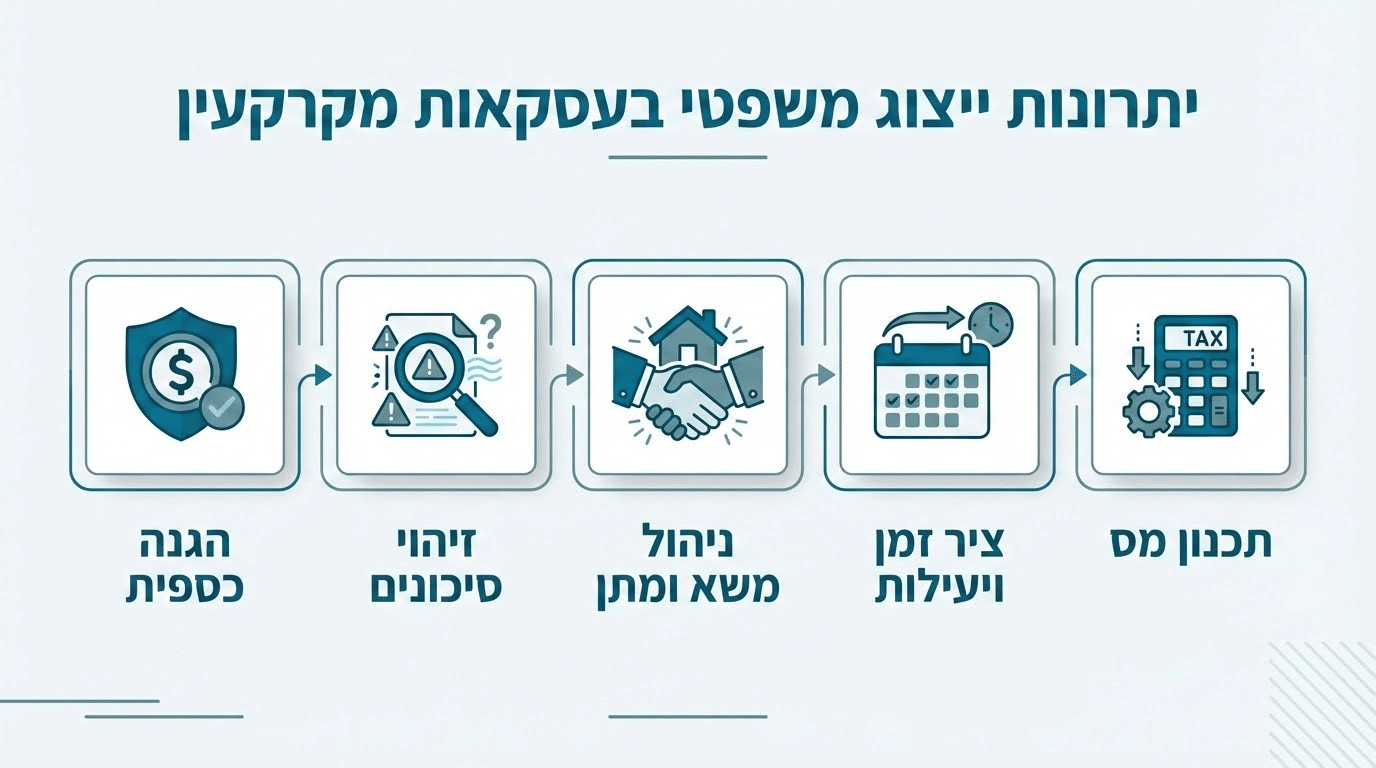
Benefits of professional legal support in a property transaction
| Business need | How legal support helps in practice |
|---|---|
| Protecting funds | Checking security, registering cautionary notes and monitoring payments |
| Identifying risks | Comprehensive title and planning checks before commitment |
| Negotiation | Securing better terms and balancing problematic clauses |
| Meeting deadlines | Timely declarations and documents, avoiding penalties |
| Tax planning | Using exemptions and reliefs for significant savings |
Investing in income-producing property: special considerations
Investment property raises additional considerations beyond buying a home. Potential returns, existing tenants and specific tax aspects must be examined. Income-producing property transactions require examination of existing leases and understanding of the local market.
A specialist lawyer examines lease terms, ensures proper transfer of rights and obligations and assists in designing the optimal tax holding structure.
Frequently asked questions about property lawyers
Is a lawyer mandatory in a property transaction?
There is no legal obligation, but legal support is essential in practice. Some required declarations must be signed before a lawyer. Property transactions are legally complex and carry significant risks that an experienced lawyer can identify and prevent.
What is the difference between a property lawyer and a real-estate lawyer?
They are effectively the same specialisation: real estate means immovable property. The terms are used interchangeably for lawyers specialising in transactions involving property.
How long does a typical property transaction take?
A resale transaction generally takes two to twelve months from signing to possession. Developer purchases may take several years, depending on the construction stage.
Can the seller’s lawyer also represent the buyer?
It is theoretically possible with both parties’ consent, but not recommended. Each has different interests, and separate representation ensures full protection for each.
When should I consult a lawyer: before or after finding a property?
Preferably during the search, particularly for a first transaction. The lawyer can explain the process and begin checks immediately once a suitable property is found.
Does the lawyer also handle the mortgage?
The lawyer coordinates with the mortgage bank and checks that conditions match the contract, but does not replace the bank’s own mortgage-approval process.
Unsure how to proceed with your property transaction?
Every transaction differs, and every property presents unique challenges. An initial consultation with an experienced property lawyer can save time, money and distress later.
About the author

Adv. Uri Shiloh
A lawyer since 1985, practising litigation, property, planning and building, cooperative associations, entrepreneurship and innovation. An arbitrator and mediator in commercial, planning and building matters and disputes with government authorities.
Specialises in managing complex crises outside court. Served as legal adviser and prosecutor for local planning and building committees by appointment of the Attorney General.
More than 40 years’ experience
Certified arbitrator and mediator
More than 2,000 property transactions