
Fire resistance in CLT: how does a mass-timber panel withstand a fire?
Automatically translated. Read the original
Planning, Construction and Regulation Department, E. Shiloh & Co., Attorneys at Law
When we think of wood and fire, we picture twigs in a campfire. But CLT, Cross Laminated Timber, behaves completely differently. It is a massive volume of dense timber, and the physics of its burning is the key to its safety.
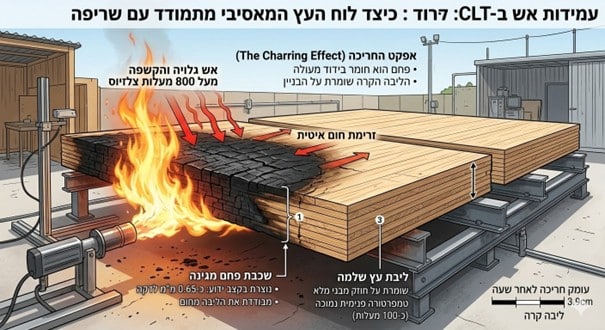
The charring effect
When mass timber is exposed to fire, its outer layer turns to charcoal. This charcoal is not ordinary “fuel”—it acts as a natural insulating layer.
- A known charring rate: Fire engineering knows precisely how quickly CLT chars: approximately 0.65 mm per minute.
- Protection of the core: While the outer layer chars, the timber core remains cool and dry, retaining its full structural strength.
- Comparison with steel: Whereas steel weakens and suddenly collapses at high temperatures, CLT continues supporting the building's weight for a long time, allowing safe evacuation.
How do international standards address this?
The potential is already understood around the world, and regulation has progressed accordingly:
The European standard, Eurocode 5, defines rigorous calculation methods for the fire resistance of timber structures. Designers must demonstrate that the structure can withstand specified periods—for example R60 or R90, meaning 60 or 90 minutes of structural resistance under fire—by calculating the wall thickness remaining after charring.
Recent years have brought dramatic changes to the International Building Code. The American standard, IBC 2021, now permits timber buildings up to 18 stories, divided into protection categories:
- Exposed timber: Permitted in lower buildings or with advanced sprinkler systems.
- Clad timber: (Encapsulated) In particularly tall buildings, CLT panels are covered with fire-resistant plasterboard, adding a protective layer that has prevented fire from reaching the timber itself for hours.
Research institutes around the world have conducted full-scale fire tests in which entire CLT apartments were set alight. The results showed that in many cases the fire extinguished itself once the combustible contents of the home, such as furniture, had burned, because the CLT's char layer did not have enough oxygen to continue burning inward.
And what is happening in Israel?
Suitable standards are not yet in place. Legal and regulatory support is critical: the fire and planning authorities must be shown that the engineering design meets the strictest international standards. E. Shiloh & Co., Attorneys at Law advises advanced-construction developers to establish the understanding that CLT innovation enhances safety rather than compromising it. By combining European standards with intelligent engineering, we will help pave the way for safer, more advanced construction.
The firm E. Shiloh & Co., Attorneys at Law specializes in real estate, planning, construction and regulation. Attorney Uri Shiloh and attorney and architect Lior Datz guide complex projects through the planning authorities to ensure that bureaucracy does not halt technology and reconstruction.
For more information and to arrange legal consultation: 🌐 E. Shiloh & Co., Attorneys at Law website
#RealEstate #PlanningAndConstruction #RebuildingTheNorth #RebuildingTheSouth #AdvancedConstruction #CLT #PropertyLaw #ConstructionInnovation #E_Shiloh_And_Co