
A guide to CLT technology: cross-laminated timber
Automatically translated. Read the original
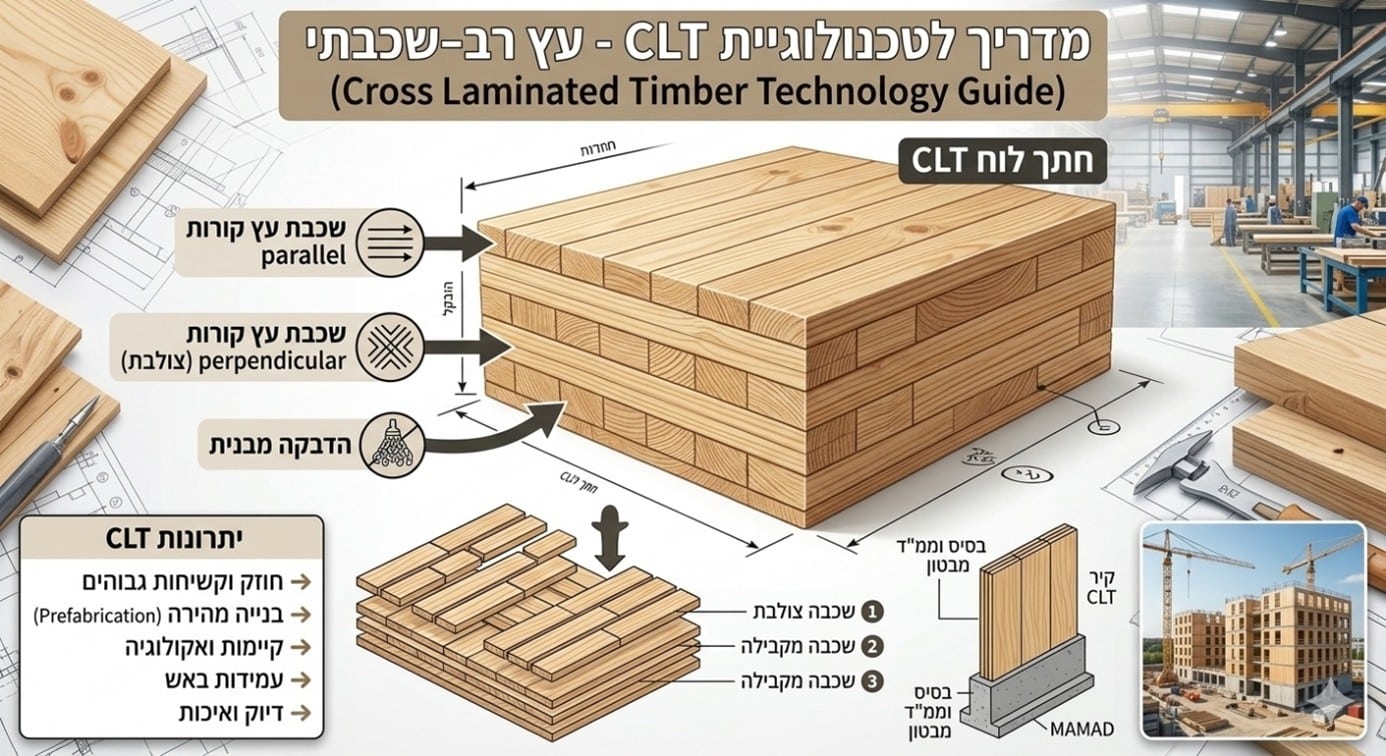
If you look at construction sites around the world in recent years, you will see something surprising: skyscrapers rising from timber frames. These are not the wooden cabins of the past, but CLT, or Cross Laminated Timber—an engineering technology changing everything we thought about stability, speed and sustainability.
So what exactly is CLT?
Think of an engineered “super-plywood.” CLT panels consist of layers of sawn timber boards glued together crosswise, at 90-degree angles. This cross-laminated structure gives the panel exceptional structural strength, earthquake resistance and stability, allowing its use as load-bearing walls and floors in tall buildings.
How is a building constructed using this method?
CLT construction is more “assembly” than traditional wet construction, and it happens on astonishing schedules:
- Fully digital design (BIM): Everything starts on a computer. Every window, electrical socket and pipe opening is planned in advance to the millimeter.
- Industrial production (CNC): The design is sent to a factory, where computer-controlled cutting machines produce the timber panels with perfect precision.
- The base and core: In Israel, construction generally combines a reinforced-concrete base and protected rooms, forming the building's protective and structural “anchor.”
- On-site assembly: CLT panels arrive numbered and ready. A small team with a crane assembles the building's walls and floors like a giant Lego set. An entire floor can be erected in just a few days, without concrete drying times or cumbersome scaffolding.
- Envelope and protection: After assembly, the structure receives waterproofing, thermal insulation and exterior cladding—stone, render or treated timber—to protect it from weather and pests.
The result?
A building constructed in 50% of the time, or even less, with natural thermal insulation that saves substantial energy costs and a negative carbon footprint: timber stores carbon rather than emitting it.
CLT is not merely an ecological solution; it is the key to better-quality, quieter and more precise construction for everyone's future.
Interested in learning more about the regulatory aspects of this construction in Israel? Or about its fire resistance? The firm E. Shiloh & Co., Attorneys at Law specializes in real estate, planning, construction and regulation. Attorney Uri Shiloh and attorney and architect Lior Datz guide complex projects through the planning authorities to ensure that bureaucracy does not halt technology and reconstruction.
For more information and to arrange legal consultation: 🌐 E. Shiloh & Co., Attorneys at Law website
#RealEstate #PlanningAndConstruction #RebuildingTheNorth #RebuildingTheSouth #AdvancedConstruction #CLT #PropertyLaw #ConstructionInnovation #E_Shiloh_And_Co